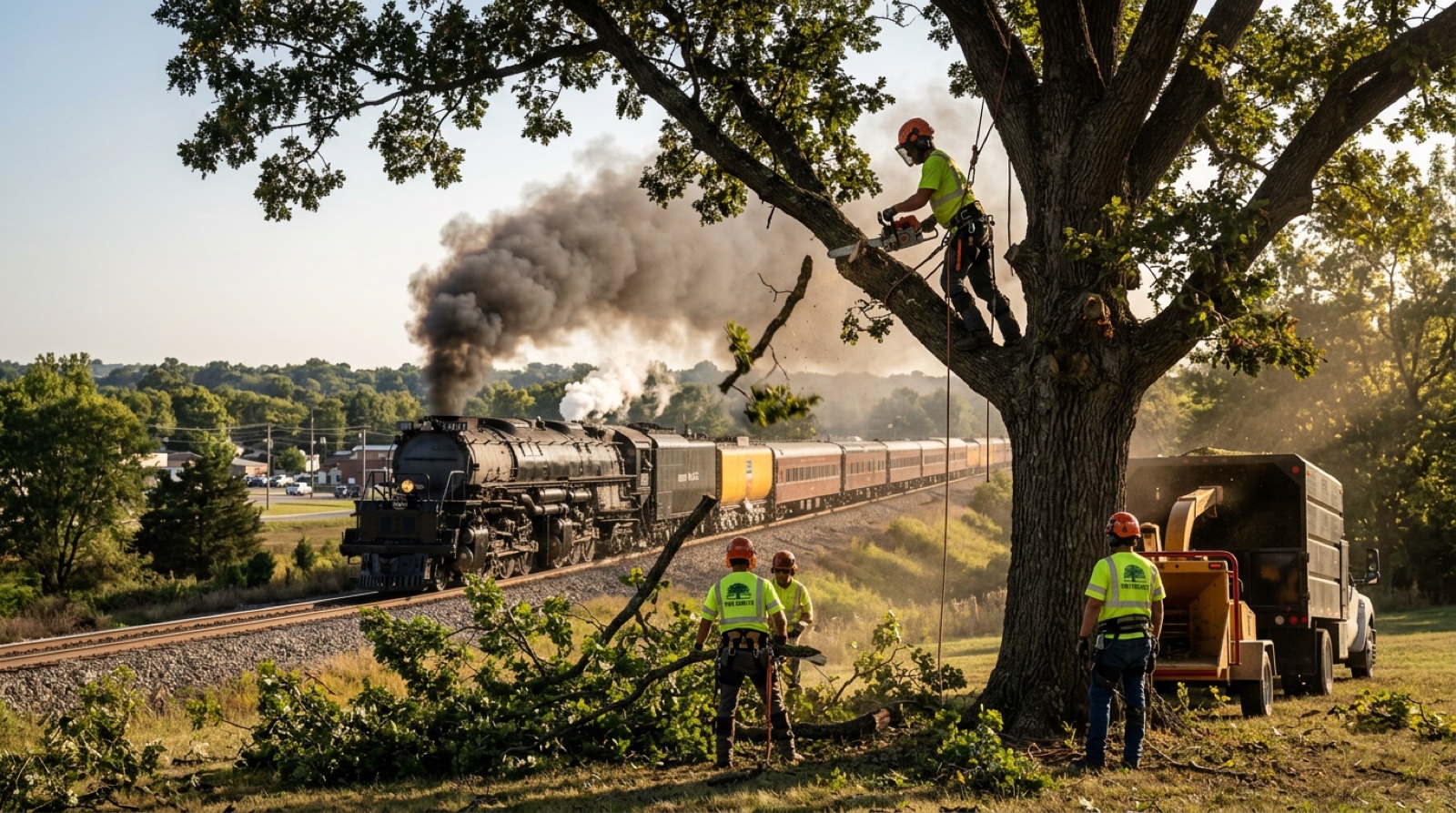
If you are heading downtown on Thursday, July 23 to see Union Pacific's Big Boy No. 4014, arrive early and look up before you park. Thousands of people will be crowding around the Great Overland Station, and a lot of them will end up standing or parking under mature street trees that have not been touched in years.
WIBW reported that the locomotive is expected at the Great Overland Station around 12:15 p.m., with the station hosting a watch party beginning at 10 a.m. You can read the details in WIBW's coverage of the Big Boy visit.
It is a genuinely great day for Topeka. It is also a useful reminder about what mid-July does to a tree canopy in northeast Kansas.
Why July Is the Worst Month to Stand Under an Unmaintained Tree
By late July, a Topeka shade tree is carrying its maximum load. Full leaf-out plus retained water weight means limbs sit lower and flex more than they did in April.
This is also the season when sudden limb drop shows up on large maples, oaks, and cottonwoods. A branch that looked fine in spring separates on a still, hot afternoon with no wind involved at all.
That combination matters when a few thousand people gather in one small area. Shade is exactly where crowds go, and shade is produced by the heaviest, most extended limbs on the tree.
What to actually check before an event day
- Limbs that hang noticeably lower this month than they did in May
- Bare or thin sections in an otherwise full canopy
- Cracks or splits where two big stems meet
- Mushrooms or soft spots at the trunk base
- Sawdust-like frass at the base, which points to borers
None of these are automatically emergencies. All of them are worth a second look before you invite people to stand underneath.
Sightlines, Signage, and the Rail Corridor
Railroads clear vegetation along their right of way for a reason. Trees near track crossings block driver visibility, obscure crossing signals, and interfere with the equipment that keeps trains and traffic separated.
The same logic applies to your property. If a limb has crept over a sidewalk, a driveway apron, or a stop sign on your corner, it is a liability question rather than an aesthetic one.
Most of that is solved with selective structural pruning and clearance work rather than removal. Raising a canopy to give pedestrian and vehicle clearance is one of the cheaper things you can do to a mature tree.
When a tree has outgrown its space entirely and is pushing into a roofline or a utility corridor, reducing the crown back to a defensible structure is usually a better outcome than topping it and hoping.
Clearance Priorities by Situation
| Situation | Typical concern | Usual fix |
|---|---|---|
| Tree over a public sidewalk | Low limbs, head strike risk | Canopy raise to standard clearance |
| Tree near a driveway or alley | Blocked sightline | Selective lateral pruning |
| Dead or declining tree near parking | Limb or trunk failure | Removal, then site cleanup |
| Overgrown fence line or lot edge | Brush, volunteer trees | Clearing and mulching |
| Storm-damaged tree left from spring | Hanging or cracked limbs | Hazard limb removal |
Dead Trees Do Not Wait for Autumn
Shawnee County properties tend to accumulate one or two standing dead trees that everyone has mentally filed under "deal with it later." Later usually means the first strong storm line that comes through in August.
A dead tree loses structural integrity from the top down and from the inside out. Taking a dead tree down on a calm weekday costs a fraction of what it costs to clean up after it lands on something.
If a tree is stressed rather than dead, that is a different conversation. Heat, compacted soil, and construction damage are all fixable, and a proper health assessment will tell you whether the tree is worth saving before you spend money on it.
For Businesses Along the Route
Downtown Topeka businesses expecting foot traffic on the 23rd have a short window. If your storefront tree is blocking a sign or dropping small debris onto a patio, that is a same-week job for most crews.
Property managers with multiple sites across Topeka and Lawrence often batch this work rather than calling site by site. Scheduled commercial maintenance keeps clearance consistent and avoids the scramble before every event weekend.
Larger parcels with encroaching brush along the edges are a separate task. Clearing overgrown ground restores usable space and removes the fuel and cover that makes everything else harder to manage.
Go See the Train
4014 retired in 1961 after more than a million miles, sat in a museum, and came back to service in 2019. Seeing it move under its own steam through Topeka is not a common thing.
Enjoy it. Then take ten minutes in your own yard and look up at what is hanging over your roof, your driveway, and your neighbor's fence.
If something looks wrong, get in touch for a straight assessment and a quote. We work across Topeka, Shawnee County, Lawrence, and the surrounding northeast Kansas communities, and we will tell you honestly if a tree can wait.