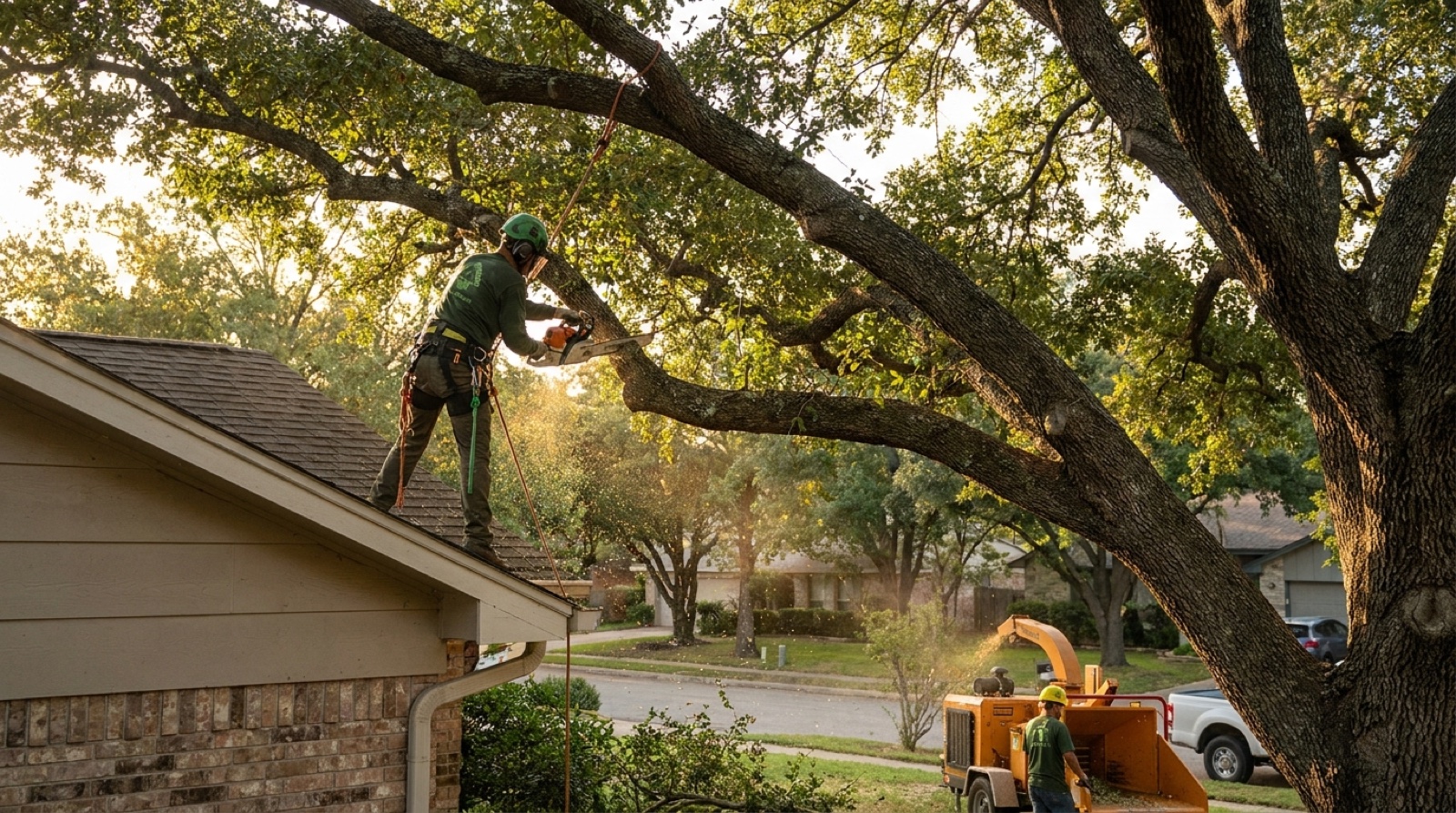
Growth is the thing that gets measured last
A limb that clears your roofline this August will not clear it three summers from now. Silver maple, hackberry and Siberian elm all put on serious length in a single Kansas growing season.
Clearance is a schedule, not a one time job. Most of the limb damage we see in Topeka comes from growth nobody measured, not from a storm nobody saw coming.
Big Boy needed a clear corridor through Shawnee County
Union Pacific's Big Boy No. 4014, the largest operating steam locomotive in the world, pulled into the Great Overland Station on Thursday, July 23, 2026. It was crossing the country on a tour marking America's 250th anniversary.
After Topeka it kept rolling west toward Cheyenne, Wyoming. WIBW covered the arrival and the crowd it pulled in.
A machine that size does not move through a metro area on luck. Railroads keep a defined envelope of open space above and beside the rails, and anything growing into that envelope gets cut long before a train is scheduled.
Your house sits inside an envelope too. The difference is that nobody inspects yours for you.
The clearances worth measuring on a Topeka property
Below are the working targets crews use when they lift and thin a canopy. They are practice guidelines rather than city code, and the right number for your property depends on species, lean and what sits underneath.
| Where | Target clearance | Why it matters |
|---|---|---|
| Roof and gutters | 8 to 10 feet | Stops shingle abrasion, keeps squirrels off the fascia, lets the roof dry after rain |
| Siding and windows | 3 to 5 feet | Airflow keeps paint and trim from staying damp |
| Chimney and flue | 10 feet | Heat and ember contact with live foliage |
| Over a driveway or street | 13 to 14 feet | Delivery trucks, moving vans and fire apparatus need the headroom |
| Over a sidewalk | 8 feet | Nobody should have to duck on their own block |
| Around a security light | Full throw of the beam | A blocked light is the same as no light |
Roofs take the most abuse
A branch resting on composition shingles does not need wind to do damage. Normal daily thermal movement is enough to sand the granules off a strip of roof over a couple of seasons.
That is the cheapest problem on this list to prevent. A canopy lift and selective thinning costs a fraction of a roof section.
Power lines are not a homeowner clearance project
Evergy handles vegetation around its own distribution lines here in Topeka. The service drop that runs from the pole to your weatherhead is a different conversation, and it is still energized.
OSHA sets a ten foot minimum approach distance to energized lines for anyone without line clearance qualification. That covers essentially every homeowner holding a pole saw.
If a limb is anywhere near a conductor, stop and call. This is not a judgment call to make from a ladder.
August is the wrong month for heavy cuts
Late summer in northeast Kansas means heat, dry soil and trees running down their stored energy. Large reduction cuts made now push a flush of soft growth that will not harden off before the first hard freeze.
Light clearance work is fine in any month. Pulling deadwood, lifting a limb off a roof and opening a sight line at the end of a driveway do not meaningfully stress a healthy tree.
What to schedule when
- Now: deadwood removal and anything touching the house. Dead limbs come down on their own schedule.
- December through February: structural pruning. Cuts close cleanly, the structure is visible with the leaves off, and beetle pressure on elms and oaks is at its lowest.
- Winter, planned in advance: reducing a crown that has outgrown its space, which is a staged job rather than a single visit.
- Early fall: soil and root work. Compacted clay is the limiting factor on plenty of Topeka lots, and addressing root zone conditions does more for a struggling tree than another round of pruning.
When clearance is not the answer
Some trees cannot be pruned into the space they were planted in. A silver maple six feet off a foundation is a maintenance subscription with no end date.
Topping a tree back every other year to hold it off the house makes the problem worse. The regrowth attaches weakly at the cut points and fails in exactly the wind events you were trying to protect against.
When the pruning cycle gets shorter every round, run the ten year math. Taking the tree out and replanting something appropriately sized is often the cheaper and safer end of the ledger.
A ten minute walk around your house
Take a tape measure and a phone. Note anything that comes up short so you have a record.
- Stand at each corner of the house and look up. Is anything touching or nearly touching the roof?
- Walk the driveway. Would a moving truck clear the lowest branch?
- Check the sidewalk and the mailbox approach.
- Look at the chimney and any vent stacks.
- Scan for dead limbs held up in the canopy, especially in ash and cottonwood.
- Look at where the service drop enters the house, from the ground, without touching anything.
Two or more short measurements means it is worth having someone look at the whole canopy rather than one branch. You can get in touch for a quote and we will walk the property with you across Topeka, Shawnee County and the surrounding northeast Kansas towns.