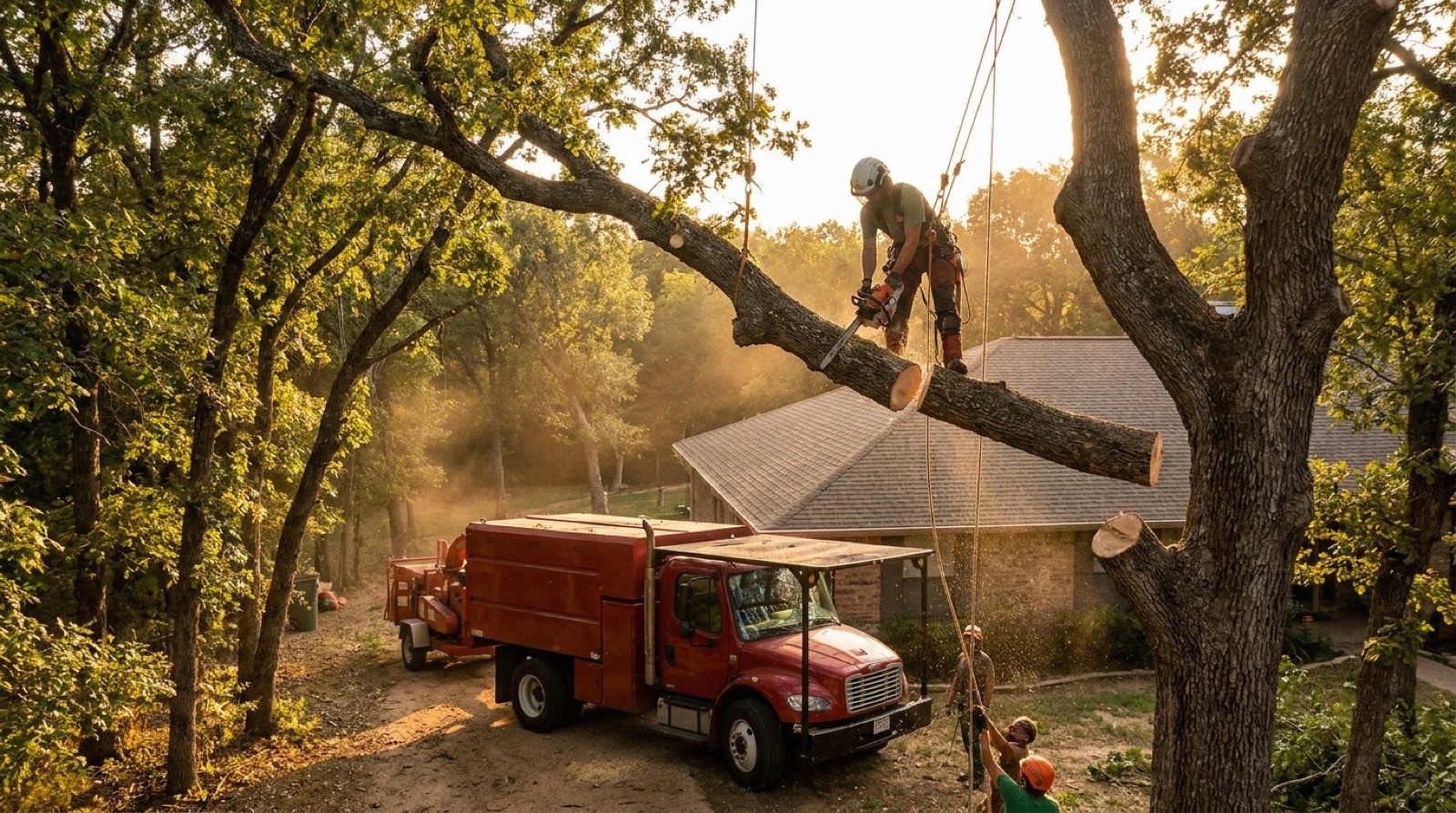
If a limb can reach it, it can eventually land on it. Railroads have worked from that rule for a century, and it applies just as cleanly to your driveway, your gutters and the wire running to your meter.
Union Pacific's Big Boy No. 4014, the largest operating steam locomotive in the world, pulled into Topeka around midday on Thursday, July 23, stopping at the Great Overland Station before continuing west toward Salina on its coast-to-coast tour. WIBW covered the arrival and the crowds that turned out for it in its report on the Topeka stop.
What nobody in those crowds was looking at is the reason the run happened at all. Every mile of that corridor is kept clear of vegetation on purpose, year after year, whether a famous locomotive is coming or not.
The Clearance Envelope, Borrowed From the Railroad
A rail corridor has a defined space around the track that stays empty. Nothing grows into it, and anything that starts to is cut back before it becomes a problem.
Your property has the same envelopes, you just have not drawn them. The roof plane, the driveway, the walk to your front door and the service drop from the pole are all spaces where a branch is either present or absent.
The difference between a homeowner who has trouble in a Kansas thunderstorm and one who does not is usually just this. One of them cut the limb back while it was two inches thick and reachable from the ground.
Where Topeka Properties Lose Clearance First
These are the spots we find overgrown on nearly every estimate we run in Shawnee County. None of the figures below are code requirements, they are simply what we aim for when we plan a job.
| Where | Clearance we aim for | Why it matters |
|---|---|---|
| Roof and gutters | 6 to 10 feet | Stops shingle abrasion, keeps debris out of gutters, removes the squirrel bridge |
| Over the driveway | About 14 feet | Delivery trucks, moving vans and service vehicles pass under without scraping |
| Over sidewalks | About 8 feet | Nobody ducks, and low limbs stop taking hits from mowers and pedestrians |
| Around the chimney | 10 feet plus | Draft and ember safety, plus a clear path for inspection |
| Utility service drop | Leave it alone | Line clearance is Evergy's work, not a homeowner's and not a general crew's |
That last row is not negotiable. If a limb is touching or near the wire that feeds your house, call the utility and let their line clearance crew handle it.
Late July Is a Working Window, With One Big Exception
Midsummer is a perfectly reasonable time to do clearance work on most species in northeast Kansas. Full leaf makes deadwood obvious, and you can see exactly where a canopy is sitting on a roof.
Oaks are the exception. Standard regional guidance is to avoid non-emergency pruning of oaks during the active growing season because fresh wounds attract the beetles associated with oak wilt, so we schedule oak work for the dormant months unless the limb is an active hazard.
What we will do in July
- Elevate limbs off roofs, drives and walkways
- Remove deadwood and hangers left over from spring storms
- Thin and lighten overextended limbs through selective pruning work
- Reduce a top-heavy canopy where a whole tree has outgrown its spot, which is where crown reduction and restoration earns its keep
What usually waits for winter
- Heavy structural pruning on healthy oaks
- Large reduction cuts on already stressed trees
- Non-urgent work on anything showing drought decline
Dead Wood Is the Part That Actually Falls
Living limbs bend in a straight-line wind. Dead ones snap, and they snap without warning at the worst possible moment.
A tree that lost its leaves early, has bark sloughing off in sheets, or is holding mushrooms at the base is not going to recover into a safe tree. At that point taking the dead tree out costs less than waiting, because a standing dead trunk near a house has to come down in controlled pieces rather than being felled in one go.
Where a tree is sound but simply in the wrong place, growing into a foundation or leaning over a bedroom, full removal is the honest answer instead of pruning it into a stump on a stick every three years.
Do the Walk Before the Next Storm Line
Kansas gets its share of August and September wind events, and the trees that fail are almost never a surprise in hindsight. Spend fifteen minutes doing what a railroad inspector does.
- Stand at the street and look at your roofline. Anything touching it goes on the list.
- Walk the driveway and look up. If a truck would scrape, so will an ice load.
- Circle each large tree and look for dead tips in the upper third.
- Check for cracks where two trunks meet in a tight V.
- Note anything leaning toward a structure that was not leaning last year.
If something already came down, our storm cleanup crews work across Topeka, Lawrence and the surrounding northeast Kansas communities and can usually get a road or drive opened the same day.
Get a Set of Eyes on It
A walkthrough costs nothing and takes about twenty minutes on an average lot. You will get a straight answer about what needs doing now, what can wait until the trees go dormant, and what is genuinely fine.
Call us at (785) 783-0436 or send over a few photos and your address and we will get you a written quote.