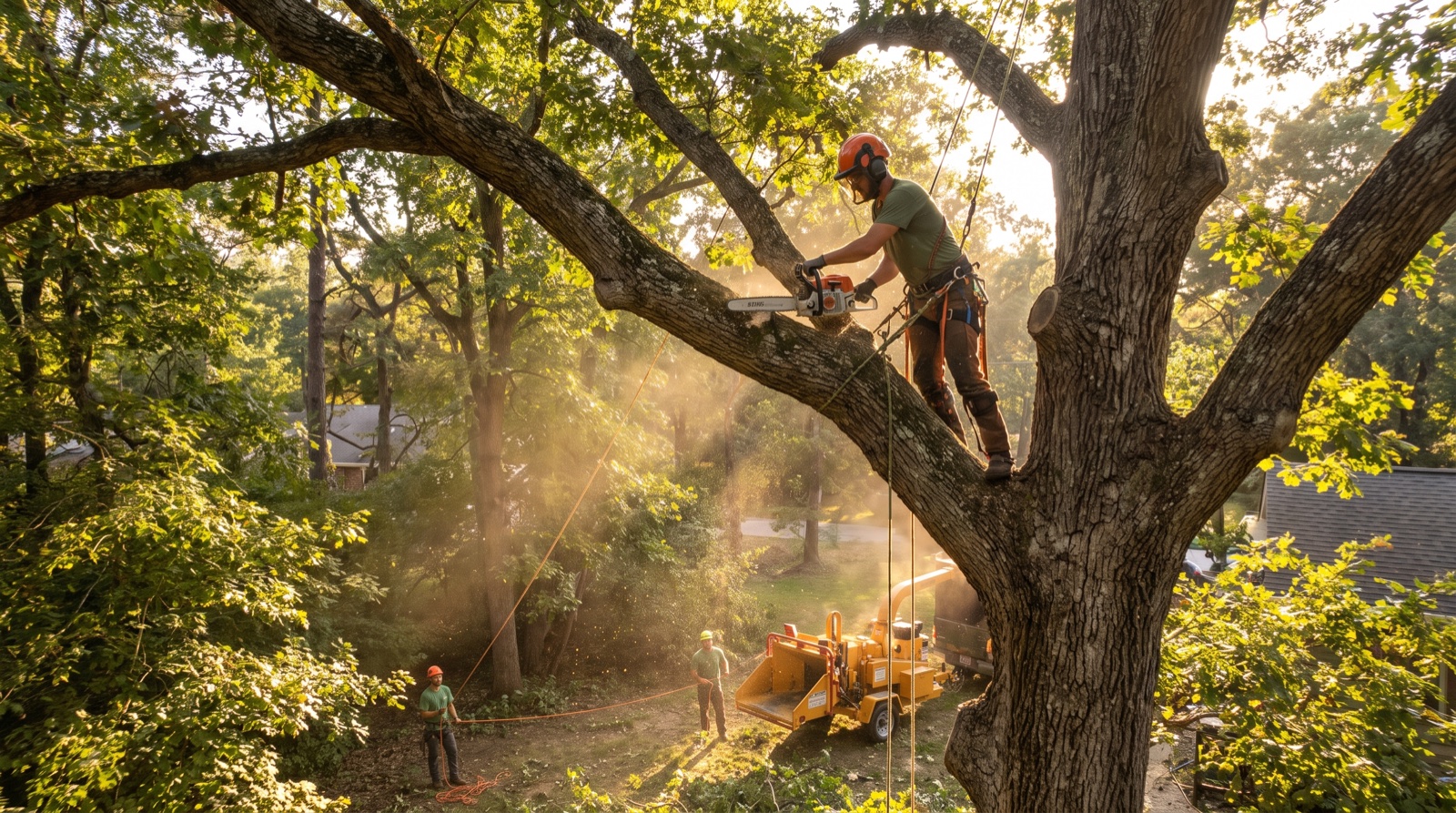
Most mature shade trees need trimming every 3 to 5 years. Young trees need it every 2 to 3 years, and fruit trees do best with a light pruning every year.
Those numbers shift with species, growth rate, and how close the tree stands to your house or power lines. A silver maple hanging over a roof in Topeka runs on a very different schedule than a bur oak in an open back yard.
Trimming Frequency by Tree Type
Growth rate is the biggest factor. Fast growers put on long, weak limbs quickly, while slow growers hold their shape for years.
| Tree type | Common examples | Typical interval |
|---|---|---|
| Young trees (first 10 years) | Any newly planted shade tree | Every 2 to 3 years |
| Fast growing shade trees | Silver maple, Siberian elm, cottonwood, Bradford pear | Every 2 to 3 years |
| Moderate growers | Hackberry, honeylocust, red maple | Every 3 to 4 years |
| Slow growing hardwoods | Bur oak, pin oak, black walnut | Every 4 to 5 years |
| Fruit trees | Apple, pear, peach, cherry | Every year |
| Ornamentals | Redbud, crabapple, dogwood | Every 2 to 3 years |
| Evergreens | Eastern redcedar, pine, spruce | Every 5 to 7 years, or as needed |
Young trees
The first decade matters most. Structural pruning every 2 to 3 years sets a single strong leader and well spaced branches, which prevents expensive problems later.
A small cut on a young tree closes fast. The same correction on a 40 foot tree means a large wound and a much bigger bill.
Fast growers
Silver maples, Siberian elms, and Bradford pears are common across northeast KS, and they are the trees that fail most often in wind and ice. Their wood is brittle and their branch unions are often weak.
Keeping them on a 2 to 3 year cycle lets a crew reduce end weight and remove poorly attached limbs before a storm does it for you.
Oaks and other slow hardwoods
Oaks can go 4 to 5 years between visits. Timing matters more than frequency here, because oak wilt is present in Kansas and spreads through fresh cuts made in spring and early summer.
Schedule oak pruning for the dormant season, roughly November through February.
Fruit trees
Fruit trees are the exception to the multi year rule. Annual pruning in late winter opens the canopy to light, keeps fruit within reach, and limits disease.
Evergreens
Most conifers need very little. Remove dead or damaged limbs when they show up, and avoid cutting back into bare wood because most species will not regrow from it.
How Your Goal Changes the Schedule
The reason you are trimming matters as much as the species.
- Safety: Dead, cracked, or hanging limbs should come out as soon as you spot them, regardless of the schedule.
- Health: Removing diseased, rubbing, and crowded branches every 3 to 5 years is enough for most mature trees.
- Clearance: Limbs over roofs, driveways, and sidewalks usually need attention every 2 to 3 years.
- Size control: Holding a tree smaller than its natural size takes the most frequent work, often every 1 to 2 years.
- Appearance: Shaping ornamentals is typically a 2 to 3 year job.
If a tree has outgrown its space, repeated hard cutting is the wrong fix. A planned crown reduction lowers height and spread with proper cuts instead of topping.
Trees Close to Structures Need Shorter Intervals
Distance from a target shortens every interval in the table above. A limb that fails over open lawn is a cleanup job, while the same limb over a bedroom is an insurance claim.
As a working rule, keep branches 6 to 10 feet clear of the roof and well away from siding, gutters, and chimneys. Trees inside that range should be checked every year and trimmed every 2 to 3 years.
Never trim near power lines yourself. Call your utility about anything touching the lines, and leave the rest to a licensed crew.
Signs a Tree Is Overdue
- Dead branches larger than 2 inches in diameter
- Limbs touching or scraping the roof, siding, or wires
- Branches that cross and rub against each other
- A canopy so dense that wind cannot pass through it
- Clusters of thin upright shoots growing from old cuts
- Cracks or splits where large limbs join the trunk
Any one of these is a reason to move the next visit up. Cracked unions on large limbs may also call for cabling or bracing in addition to pruning.
How Much to Remove at One Time
Frequent, light pruning is better than rare, heavy pruning. Taking more than about 25 percent of the live canopy in one season stresses the tree and triggers weak regrowth.
Mature and stressed trees tolerate even less. Kansas summers are already hard on trees, so avoid heavy cuts during heat and drought.
Thinning leaves, slow growth, or dieback at the branch tips point to a problem that trimming alone will not solve. In those cases a tree health assessment should come before any cutting.
Setting a Schedule for Your Property
Walk your yard once a year, ideally after leaf drop when the branch structure is easy to see. Note the species of each tree, when it was last trimmed, and what it could hit if a limb came down.
Our crews handle professional trimming and pruning across Topeka, Shawnee County, and Lawrence. Call (785) 783-0436 or request a free quote and we will tell you which trees need work now and which can wait.