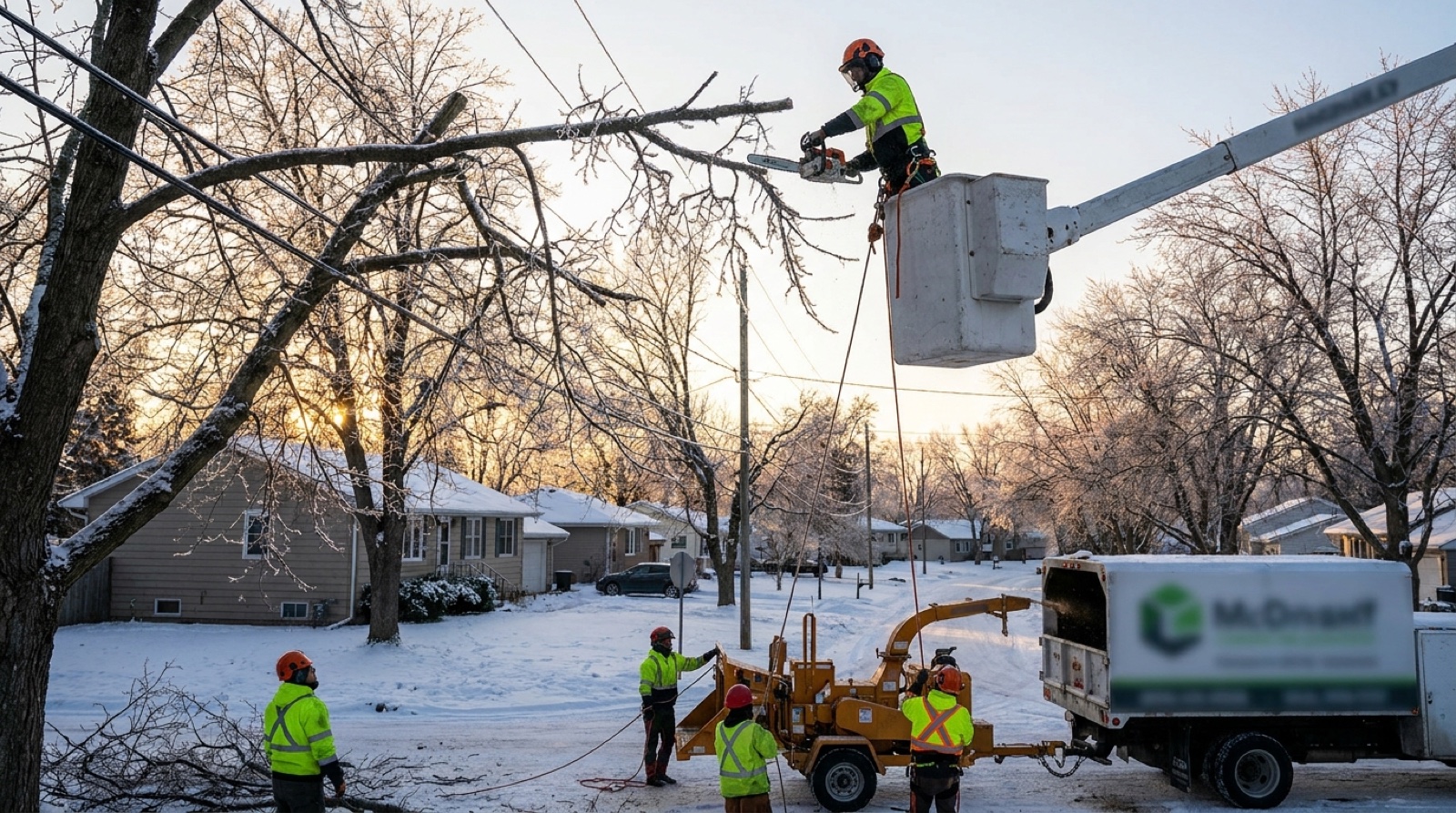
Book Structural Work Now, Not After the First Ice
If you own a mature shade tree in Topeka, the practical window for structural pruning runs from late August through early December. Waiting until ice is in the forecast means competing with every other homeowner in Shawnee County for the same handful of crews.
That timing matters more than usual this year. The Farmers' Almanac long range outlook places Kansas in a zone expected to see a cold season punctuated by sudden cold snaps and snowy stretches, as covered by The Topeka Capital-Journal on August 7, 2026.
What the Forecast Actually Says
The Almanac groups Kansas with Nebraska, Missouri, Iowa and the northern Plains states rather than treating Topeka on its own. For that whole block it calls for a cold winter that turns snowy at times, with breezy conditions and abrupt drops into bitter cold.
A long range almanac is not the National Weather Service, and nobody should treat it as a precise schedule. It is still a reasonable prompt to walk your property while the ground is dry and crews are still taking routine appointments.
The word worth focusing on is sudden. Rapid temperature drops following a wet stretch are exactly how glaze ice forms on limbs across northeast Kansas.
Why Sudden Cold Is What Breaks Limbs
Ice adds weight silently and fast. Even a modest accumulation multiplies the load on a long horizontal limb, and that limb does not have to be dead or diseased to fail under it.
Wind finishes the job. A canopy already loaded with ice catching a strong gust behaves like a sail bolted to the end of a lever.
Older Topeka neighborhoods carry a lot of fast growing shade species planted decades ago for quick canopy. Those are the trees that end up across driveways and power drops in January.
Species That Tend to Fail First Around Here
| Tree | Typical failure | What usually helps |
|---|---|---|
| Silver maple | Split at a tight double stem union | Support hardware plus weight reduction |
| Siberian elm | Brittle wood shedding whole limbs | Deadwood and end weight pruning |
| Callery or Bradford pear | Whole tree splitting down the middle | Often replacement rather than repair |
| Hackberry | Dead upper canopy dropping in wind | Clean out the crown |
| Cottonwood | Sudden large limb drop | Reduction of overextended limbs |
A Realistic Fall Checklist
You do not need to do everything. You need to do the few things that change how a tree behaves under load.
- Clear the deadwood. Dead limbs are the first to come down and the most likely to hit something, so a proper canopy cleaning and pruning visit is the highest value hour you will buy this fall.
- Shorten the leverage. Overextended limbs reaching for the driveway or the neighbor's fence are candidates for crown reduction, which cuts the sail area without gutting the tree.
- Support the weak unions. A tight V shaped fork on a big maple is a known failure point, and cabling and bracing can hold it together through an ice event.
- Deal with the tree you already know is dead. Standing dead wood does not get safer with a freeze, and taking it down on a calm October morning costs less than an emergency call.
- Check what is over the roof. Anything directly above a bedroom, a gas meter, or a service line deserves a closer look than the rest of the yard.
A Sensible Order of Operations
| Window | Focus |
|---|---|
| Late August to September | Walk the property, flag hazards, get on a schedule |
| October | Removals and heavy structural work while access is easy |
| November to December | Dormant pruning, cabling, final cleanup before hard freezes |
| January onward | Response work only, when weather allows |
Two Things Not to Do
Do not top a tree to make it shorter. Topping triggers dense clusters of weakly attached regrowth, which means the tree carries more ice on worse attachments the following winter.
Do not rush oak pruning during warm weather. In Kansas, pruning oaks in spring and early summer raises oak wilt risk, which is another reason late fall and winter are the right time for that work.
When Removal Is the Honest Answer
Some trees cannot be pruned into safety. A trunk with a large cavity, a significant lean with cracked soil at the base, or a mushroom bracket at the root flare all point toward decay that pruning does not fix.
In those cases planned removal before winter is cheaper and safer than the alternative. If the worst happens anyway, storm damage cleanup crews across Topeka, Lawrence and the rest of Shawnee County get booked solid within hours of a major ice event.
Get a Set of Eyes on It
Most Topeka properties need one or two targeted jobs, not a full canopy overhaul. A walkthrough tells you which is which before the weather decides for you.
Call (785) 783-0436 or request a quote and we will tell you plainly what needs doing this fall and what can wait until spring.